


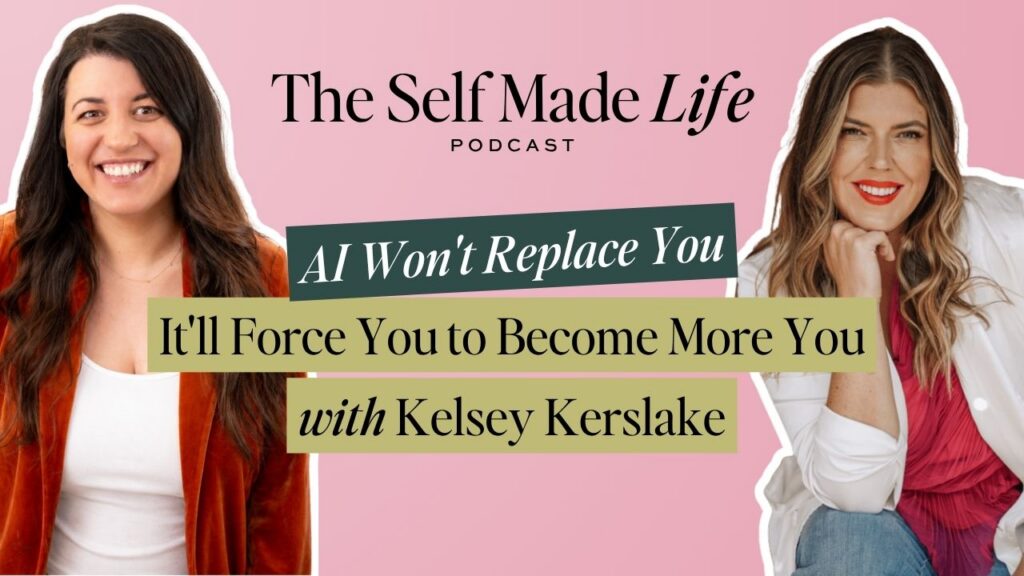
AI Won’t Replace You, It’ll Force You to Become More You
TLDR;
Kelsey Kerslake built a seven-figure coaching business. Then a rare immunodeficiency diagnosis forced her to step back from most of it. She started using AI as a coach and emotional sounding board during the hardest season of her health journey. That experience became the seed for Soul, an AI coaching tool built inside her program The Art of Becoming. This post covers what AI coaching for entrepreneurs actually looks like when you use it to process and grow, not just produce.
AI Coaching for Entrepreneurs: What Kelsey Kerslake Learned From Rebuilding Her Business Twice
You’ve probably heard someone talk about using AI to write faster captions or knock out an email in half the time. That’s not this.
Kelsey Kerslake built The Align Business into a seven-figure coaching program with a team of five. Then her body made the decision for her. A rare immunodeficiency put her in and out of hospitals for three years. Only one other known person shares her diagnosis. Eventually, she had to stop almost everything and rest.
That’s where AI coaching for entrepreneurs entered the picture. Not as a hustle tool. As a way to process everything happening to her business and her identity at once.
AI Coaching for Entrepreneurs Starts With Talking, Not Prompts
Kelsey didn’t start with prompts. She started by talking, the same way she’d talk to a therapist or a friend. This tool never slept and never got tired of hearing her out. She’d tell it what was going on, see what came back, and push back when the response didn’t land.
For about a month, she says she was “beating ChatGPT up.” She corrected the tone, the assumptions, the missing context, until it started to actually reflect how she thinks and processes. That back-and-forth eventually shaped Soul, the AI coaching tool she built inside The Art of Becoming.
Grieving the Business She Built, With AI as Her Coach
The hardest part of stepping back wasn’t logistics. It was identity. Kelsey had built her goals, her team, and her sense of self around scaling to seven figures and beyond. Her health forced her to let that go. She never gave herself space to grieve the program she’d built and loved. She was too busy surviving.
A lot of established service providers will recognize that pattern, even without a health crisis attached. You outgrow a version of your business, or circumstance takes it from you, and you never build in time to grieve it.
What Makes an AI Coach Different From a Chatbot
The distinction Kelsey draws is specific. When you open ChatGPT or Claude, you bring your own purpose to the conversation. Soul flips that. It brings the purpose out of you instead. It learns your patterns over time, notices what resonates and what doesn’t, and checks in on your progress the way an actual coach would, instead of waiting for you to ask the right question.
If brand strategy is the foundation of a strong business identity, Soul aims to do something similar for your internal identity: it builds a system around who you actually are, instead of reacting to whatever you type in that day.
Your Point of View Is the Part AI Can’t Touch
As Kelsey put it, the “doing” is going to keep getting faster and cheaper. AI won’t replicate the point of view behind the work, the reason someone chooses you specifically. For creative entrepreneurs, that point of view is the actual asset. Good AI coaching for entrepreneurs doesn’t replace that point of view. It helps you get clearer on it.
This is the same idea behind the placeholder brand episode: the tools and tactics change constantly, but your actual positioning is what clients remember and pay for.
Building a Business That Doesn’t Depend on Constant Energy
Kelsey’s health forced her to design a business that could run without her showing up at full capacity every day. That’s the piece worth sitting with, whether or not AI is part of your workflow. What does your business actually require from you to keep running? What happens if that capacity disappears for a season?
You can hear Kelsey talk through all of this in more detail on The Align Business, where she also outlines the framework behind Soul.
Frequently Asked Questions
What is AI coaching for entrepreneurs? AI coaching for entrepreneurs means using tools like ChatGPT, Claude, or purpose-built platforms like Soul to process business decisions, work through identity shifts, and get reflective feedback the way you would from a human coach.
How is Soul different from ChatGPT or Claude? Soul learns a person’s patterns over time and draws out their own vision and values, instead of only responding to the task or prompt in front of it.
Can AI replace a business coach? Kelsey doesn’t think AI can replace the human relationships and judgment a coach brings. But it can work as a 24/7 processing tool between sessions, especially for people who don’t have consistent access to coaching or therapy.


